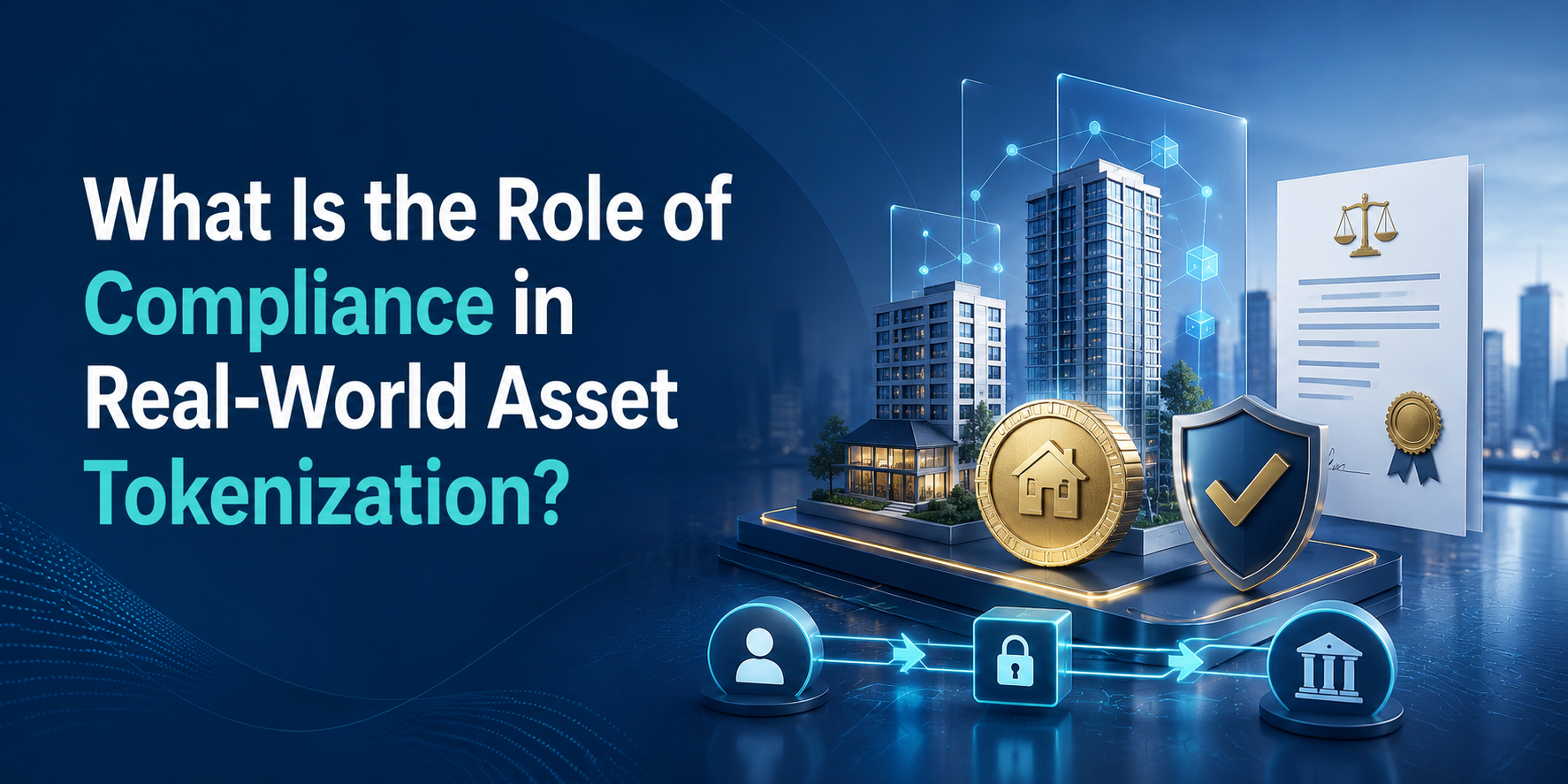
Real-world asset (RWA) tokenization is transforming how physical and traditional financial assets can be represented, transferred, and managed on blockchain networks. Instead of keeping ownership records exclusively in conventional databases, tokenization creates blockchain-based representations of assets such as real estate, government bonds, private credit, commodities, art, and investment funds. These digital tokens can potentially enable fractional ownership, automated compliance, faster settlement, and broader access to traditionally illiquid markets.
However, RWA tokenization does not work identically across every blockchain. Ethereum, Polygon, Solana, Avalanche, BNB Chain, and permissioned networks such as Canton or private Ethereum environments differ in transaction costs, execution models, interoperability, compliance capabilities, and institutional suitability. Selecting the right network is therefore a strategic decision rather than simply a technical preference.
Understanding how RWA tokenization works across blockchain networks requires looking beyond token creation. The process involves asset verification, legal structuring, smart contracts, investor onboarding, custody, compliance, issuance, secondary trading, and interoperability. The blockchain ultimately becomes one component of a broader infrastructure connecting an off-chain asset with an on-chain ownership or economic claim.
What Is RWA Tokenization?
RWA tokenization is the process of representing rights or economic interests in an off-chain asset through blockchain-based tokens. The underlying asset remains in the physical or traditional financial world, while the token provides a programmable digital representation of ownership, a claim, or another contractual interest.
For example, consider a commercial property valued at $10 million. Instead of requiring one investor to purchase the entire property, a properly structured tokenization model could divide the economic interest into 10 million digital units. Investors could acquire smaller portions, subject to applicable securities, property, and investment regulations.
The token itself does not automatically make someone the legal owner of the property. The relationship between the token and the underlying asset must be established through appropriate legal agreements, ownership structures, custodians, or special-purpose vehicles. This distinction is critical because successful RWA tokenization depends on the connection between on-chain representation and enforceable off-chain rights.
Why Blockchain Network Selection Matters
Different blockchain networks offer different combinations of scalability, decentralization, transaction costs, interoperability, privacy, and regulatory functionality.
A tokenization platform processing thousands of small transactions may prioritize low fees and high throughput. An institution issuing regulated financial products may instead prioritize permissioned access, privacy, compliance controls, and predictable settlement. A global marketplace may place greater emphasis on interoperability and liquidity.
Consequently, there is no universally “best” blockchain for every RWA project.
The network should be selected according to factors such as:
- Asset type and transaction volume
- Target investor geography
- Regulatory requirements
- Smart contract capabilities
- Transaction costs
- Network scalability
- Stablecoin and payment infrastructure
- Custody requirements
- Interoperability
- Secondary-market requirements
- Privacy and permissioning
This network-specific architecture is one reason professional RWA tokenization services typically begin with business, legal, and technical requirements before selecting the underlying blockchain.
How RWA Tokenization Works on Ethereum
Ethereum remains one of the most important environments for tokenized assets because of its mature smart-contract ecosystem, developer infrastructure, wallets, stablecoins, and broad institutional experimentation.
An Ethereum-based RWA platform can use smart contracts to define token issuance rules, transfer restrictions, investor eligibility, and other business logic. Standards such as ERC-20 can represent fungible interests, while other Ethereum token standards can support unique or more complex asset structures.
Ethereum’s major advantage is its extensive ecosystem. A tokenized asset can potentially interact with decentralized applications, wallets, custody solutions, identity systems, and other blockchain infrastructure.
The limitation is that Ethereum mainnet transaction costs and throughput can be less attractive for high-frequency or highly fragmented transactions. This has encouraged many RWA projects to explore Ethereum Layer 2 networks.
For example, an issuer could maintain Ethereum compatibility while using a Layer 2 environment to reduce transaction costs and improve scalability. This creates a model where Ethereum provides ecosystem compatibility while another execution layer handles a significant portion of transaction activity.
RWA Tokenization on Polygon and Other Ethereum-Compatible Networks
Polygon and similar Ethereum-compatible networks are attractive for projects that want Ethereum’s development environment without relying exclusively on Ethereum mainnet.
An RWA platform deployed on such a network can use familiar smart-contract frameworks while benefiting from lower transaction costs and faster execution. This can be particularly useful for fractionalized assets where numerous investors may need to transact relatively small amounts.
Imagine a tokenized real-estate portfolio containing thousands of investors. If each subscription, transfer, dividend distribution, and compliance-related operation required expensive mainnet transactions, operating costs could become significant. A lower-cost execution environment can make such applications more practical.
Ethereum-compatible networks can also simplify development because teams can use established development tools and Solidity-based smart contracts. However, network selection still requires careful consideration of liquidity, bridge architecture, security assumptions, and institutional support.
How Solana Approaches RWA Tokenization
Solana takes a different approach to blockchain scalability and is designed for high-throughput applications with relatively low transaction costs.
For RWA platforms, this can be useful when the application needs frequent transactions, rapid settlement, or a large number of token holders. Tokenized funds, stablecoins, commodities, and other financial instruments could potentially benefit from this architecture.
Solana’s ecosystem also provides token standards and infrastructure that developers can use to issue and manage digital assets.
However, technical performance alone does not determine whether a blockchain is appropriate for an RWA project. A tokenization platform must also consider custody, compliance, legal enforceability, institutional integrations, and access controls. A highly scalable network cannot compensate for inadequate asset verification or regulatory architecture.
This illustrates a broader principle: RWA tokenization is a financial infrastructure problem as much as it is a blockchain development problem.
Avalanche and Custom Blockchain Environments
Avalanche offers another model particularly relevant to organizations that need greater control over their blockchain environment. Its architecture allows projects to create application-specific blockchain environments while retaining compatibility with broader blockchain tooling.
For RWA tokenization, this can be valuable when an institution requires customized transaction rules, permissioning, or compliance mechanisms.
Suppose a financial institution wants to tokenize private credit assets but does not want unrestricted participation. Its platform could incorporate identity verification and transfer restrictions directly into the tokenization infrastructure.
This type of architecture demonstrates why enterprise RWA projects increasingly consider application-specific or permissioned environments rather than relying exclusively on public blockchains.
Permissioned Blockchains and Institutional RWA Tokenization
Public blockchains are not the only option. Institutions may use permissioned networks when privacy, identity, regulatory controls, and participant restrictions are especially important.
Networks designed for institutional finance can restrict who is allowed to participate, validate transactions, or access particular information. This can be particularly relevant for private securities, bank-issued assets, trade finance, and institutional settlement.
A permissioned environment can integrate Know Your Customer (KYC), Know Your Business (KYB), identity verification, compliance screening, and transfer restrictions more directly into the transaction lifecycle.
The trade-off is that permissioned systems may sacrifice some of the openness and composability associated with public blockchains.
Therefore, the choice often becomes a question of open liquidity versus controlled participation, although hybrid models can attempt to combine both.
The Role of Smart Contracts Across Networks
Regardless of the blockchain selected, smart contracts form the operational layer of many tokenization platforms.
A well-designed smart contract can automate:
- Token issuance
- Investor eligibility checks
- Transfer restrictions
- Distribution calculations
- Redemption
- Corporate actions
- Ownership records
- Voting mechanisms
Consider a tokenized bond. Instead of manually calculating and distributing interest to every investor, smart-contract infrastructure can be connected to payment systems and automatically distribute eligible payments according to predefined rules.
However, smart contracts cannot independently verify whether an off-chain property actually exists, whether its valuation is accurate, or whether a custodian continues to hold it. This is where oracles and trusted off-chain entities become important.
Oracles: Connecting Blockchain Data With Real-World Assets
Blockchains are generally isolated from external information. RWA platforms therefore require mechanisms for bringing reliable off-chain information on-chain.
An oracle infrastructure may provide information such as:
- Asset valuations
- Commodity prices
- Interest rates
- Payment events
- Property data
- NAV calculations
- Regulatory information
For instance, if a tokenized fund distributes returns based on an off-chain portfolio’s net asset value, the blockchain needs a reliable mechanism for receiving that information.
The oracle therefore becomes part of the trust architecture. If incorrect data enters the system, smart contracts can execute perfectly while producing an incorrect result.
Interoperability: Making RWA Tokens Move Across Networks
One of the biggest challenges in multi-chain RWA tokenization is interoperability.
Suppose a tokenized asset is issued on Ethereum, but investors want to use it in an application running on another blockchain. Moving the asset between networks raises questions about custody, ownership representation, bridge security, compliance, and double-spending prevention.
Cross-chain infrastructure can address some of these challenges through mechanisms such as messaging protocols, interoperability layers, wrapped representations, or synchronized ledgers.
But RWA interoperability is more complicated than transferring a normal cryptocurrency.
If a token represents a legal claim to an asset, simply moving its digital representation does not necessarily transfer the underlying legal claim unless the legal and technical infrastructure recognizes that transfer.
Therefore, multi-chain RWA platforms need to synchronize technical ownership, legal ownership, and compliance status.
A Practical Example: Tokenized Real Estate Across Multiple Networks
Consider a company that wants to tokenize a $50 million portfolio of commercial properties.
The first stage could involve establishing a legal entity that owns the properties. Investors then purchase compliant digital tokens representing interests in that structure.
The company could issue the primary tokens on an Ethereum-compatible network because of its mature ecosystem and lower transaction costs. An institutional investor might interact through a permissioned environment, while settlement or liquidity applications could operate on another network.
An oracle system could provide property valuations and income information. Smart contracts could manage token transfers and distributions, while identity infrastructure determines whether an investor is eligible to receive or transfer tokens.
In this architecture, the blockchain is not replacing the legal system or property registry. Instead, it provides a programmable layer connecting investors, ownership records, compliance rules, and financial operations.
Security and Compliance Across Blockchain Networks
Security becomes especially important when tokenized assets represent substantial economic value.
A vulnerability in an issuance contract, transfer mechanism, bridge, oracle, or custody system could expose investors to significant losses. Therefore, RWA platforms require more than basic smart-contract development.
Security practices may include:
- Smart-contract audits
- Formal verification for critical logic
- Multisignature administration
- Role-based permissions
- Secure custody
- Oracle validation
- Emergency controls
- Continuous monitoring
- Independent penetration testing
Compliance must also be embedded into the platform architecture. Depending on the asset and jurisdiction, this can involve securities regulations, AML requirements, KYC procedures, investor accreditation, transfer restrictions, tax reporting, and data privacy.
This is why an effective RWA tokenization solution should integrate legal and compliance considerations into the technology design rather than treating them as an afterthought.
Which Blockchain Is Best for RWA Tokenization?
There is no single answer.
Ethereum can be attractive for ecosystem depth and interoperability. Ethereum Layer 2 and networks such as Polygon can provide more economical execution. Solana can be attractive for high-throughput applications. Avalanche can support customized environments, while permissioned institutional networks can provide stronger participant controls and privacy.
The best choice depends on the project’s objectives.
For example, a retail-facing fractional ownership platform may prioritize low transaction costs and wallet accessibility. A bank issuing regulated securities may prioritize permissioning, identity, privacy, and compliance. A global tokenized asset marketplace may need interoperability across several networks.
Increasingly, the most sophisticated architectures may not rely on one blockchain at all. Instead, they can use a multi-chain strategy, assigning different functions to different environments while using interoperability infrastructure to connect them.
The Future of Multi-Chain RWA Tokenization
RWA tokenization is moving toward a more interconnected blockchain environment. Rather than asking which single network will dominate, businesses may increasingly focus on how assets can securely operate across multiple ecosystems.
The future architecture could involve Ethereum-based settlement, Layer 2 execution, specialized institutional networks, high-throughput chains, interoperable identity systems, stablecoins, and traditional financial infrastructure working together.
This evolution could make tokenized assets more accessible and programmable while reducing some of the friction associated with conventional financial processes. Nevertheless, adoption will depend heavily on regulatory clarity, institutional confidence, secure infrastructure, reliable asset servicing, and genuine secondary-market liquidity.
The most important shift is therefore not simply putting assets “on-chain.” It is creating reliable infrastructure that connects legal ownership, asset custody, compliance, blockchain records, and financial activity into one coherent system.
Conclusion
RWA tokenization works differently across blockchain networks because each network offers a distinct combination of scalability, cost, interoperability, privacy, security, and compliance capabilities. Ethereum and its scaling ecosystems provide broad compatibility, Solana emphasizes high-throughput execution, Avalanche enables customizable blockchain environments, while permissioned networks can address institutional requirements for controlled participation. As the industry matures, multi-chain architectures are likely to become increasingly important, allowing tokenized assets to operate across different ecosystems rather than remaining confined to a single network. Businesses looking to build secure and scalable tokenization platforms can work with Blockchain App Factory, which provides best-in-class RWA tokenization services and develops tailored RWA tokenization solutions designed around asset type, regulatory requirements, blockchain selection, smart contracts, compliance, and long-term scalability.
Share this content:
Post Comment