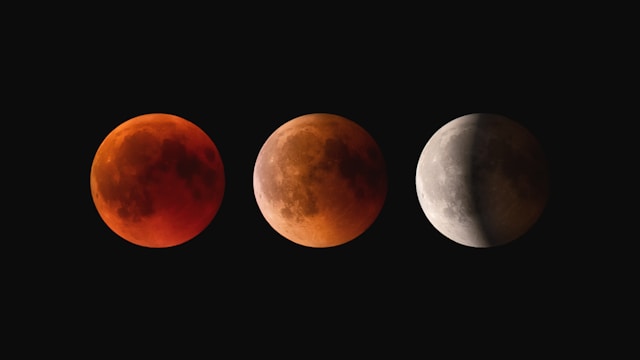
The Moon is one of the most familiar objects in the night sky, but its appearance does not stay the same. Throughout the month, we see different portions of the Moon’s illuminated side. These changing shapes are called lunar cycle moon phases.
The Moon does not produce its own visible light. Instead, sunlight illuminates different parts of its surface as it moves around Earth. From our position on Earth, this creates a repeating pattern of phases.
Understanding the lunar cycle can make stargazing more interesting and help you know what to expect when you look at the Moon on a particular night.
What Is the Lunar Cycle?
The lunar cycle is the repeating sequence of Moon phases that occurs as the Moon orbits Earth. A complete cycle from one New Moon to the next takes about 29.5 days.
During this period, the visible portion of the illuminated Moon gradually changes. It grows from a thin crescent to a Full Moon and then becomes smaller again until the next New Moon.
The main phases are:
- New Moon
- Waxing Crescent
- First Quarter
- Waxing Gibbous
- Full Moon
- Waning Gibbous
- Third Quarter
- Waning Crescent
What Causes Moon Phases?
Moon phases are caused by the changing positions of the Sun, Earth, and Moon.
Half of the Moon is always illuminated by sunlight. However, as the Moon travels around Earth, we see different amounts of that illuminated half.
The Moon itself does not suddenly change shape. The changing appearance is simply the result of our viewing angle from Earth.
The Eight Lunar Cycle Moon Phases
1. New Moon
The lunar cycle begins with the New Moon.
At this stage, the Moon is positioned roughly between Earth and the Sun. The illuminated side faces away from Earth, so the Moon is difficult or impossible to see from most locations.
The New Moon marks the beginning of a new lunar cycle.
2. Waxing Crescent
After the New Moon, a small portion of the illuminated side becomes visible.
This phase is called the Waxing Crescent. “Waxing” means that the visible illuminated portion is increasing.
The crescent gradually becomes larger each night.
3. First Quarter
The Moon reaches the First Quarter phase when approximately half of its visible face appears illuminated.
Despite its name, this phase occurs about one-quarter of the way through the lunar cycle.
It is an excellent phase for observing the Moon because shadows around craters and mountains can make surface features easier to see.
4. Waxing Gibbous
After the First Quarter, more than half of the Moon’s visible surface becomes illuminated.
This is called the Waxing Gibbous phase.
The illuminated area continues increasing until the Moon reaches Full Moon.
5. Full Moon
The Full Moon occurs when Earth is positioned approximately between the Sun and Moon.
The side of the Moon facing Earth is then largely illuminated, making it appear as a bright, complete circle.
Full Moons are among the easiest lunar phases to observe with the naked eye.
6. Waning Gibbous
After the Full Moon, the illuminated portion begins to decrease.
This stage is called the Waning Gibbous phase. “Waning” means the visible illuminated portion is becoming smaller.
Although the Moon is no longer full, a large portion remains visible.
7. Third Quarter
During the Third Quarter, approximately half of the Moon’s visible surface is illuminated again.
This phase occurs about three-quarters of the way through the lunar cycle.
The Moon then continues toward the final crescent stage.
8. Waning Crescent
The final major phase is the Waning Crescent.
Only a small portion of the Moon is illuminated and visible from Earth. The illuminated area continues shrinking until the Moon reaches the New Moon phase again.
The cycle then starts over.
Waxing vs. Waning: What’s the Difference?
Two words are especially important when learning about lunar cycle moon phases.
Waxing means the illuminated portion we see is increasing.
Waning means the illuminated portion we see is decreasing.
Therefore:
Waxing phases:
New Moon → Waxing Crescent → First Quarter → Waxing Gibbous
Waning phases:
Full Moon → Waning Gibbous → Third Quarter → Waning Crescent
How Long Does a Lunar Cycle Last?
A complete lunar cycle lasts approximately 29.5 days from one New Moon to the next.
This is called a synodic month. It is slightly shorter than a calendar month in some cases and longer in others, which is why Moon phases do not occur on the same calendar date every month.
Why Track Lunar Cycle Moon Phases?
Tracking the Moon can be useful for many reasons.
Astronomy and Stargazing
Knowing the Moon phase helps observers understand how bright the night sky will be.
Astrophotography
Photographers can plan sessions based on the amount of moonlight available.
Education
Students can use Moon phases to understand the relationship between Earth, the Moon, and the Sun.
Outdoor Planning
People interested in night-sky observation can select dates with darker skies when the Moon is less visible.
Explore Moon Phases With WorldTimeAI
WorldTimeAI provides an interactive Moon Phase tool for people interested in tracking the lunar cycle.
Users can explore information about:
- Current Moon phase
- Upcoming Moon phases
- Full Moon
- New Moon
- Lunar cycle
- Moon illumination
- Monthly lunar patterns
Visit:
https://worldtimeai.com/moon-phases.html
WorldTimeAI also provides other useful tools, including a world clock, time-zone resources, date-duration calculations, and night-sky information.
Moon Phases and the Night Sky
The Moon’s phase can have a major effect on how dark the night sky appears.
A bright Full Moon can make faint stars and some deep-sky objects harder to see. A New Moon creates much darker conditions, which can be better for observing faint celestial objects.
For this reason, checking the lunar phase before a stargazing session can be helpful.
Frequently Asked Questions
How many Moon phases are there?
There are eight commonly recognized major phases in one lunar cycle.
How long is one lunar cycle?
A complete cycle from New Moon to New Moon takes approximately 29.5 days.
Does the Moon change shape?
No. The Moon remains approximately spherical. Its apparent shape changes because we see different portions of its sunlit side.
What is the brightest Moon phase?
The Full Moon appears brightest because the side facing Earth is largely illuminated by the Sun.
What is the darkest Moon phase?
During the New Moon, the illuminated side faces mostly away from Earth, making the Moon difficult to see.
Conclusion
The lunar cycle moon phases provide a fascinating example of how the positions of the Sun, Earth, and Moon affect what we see in the sky. From the nearly invisible New Moon to the bright Full Moon and back again, the cycle repeats approximately every 29.5 days.
By understanding the eight major phases, anyone can become more familiar with the night sky. Whether you’re learning astronomy, planning a photography session, or simply enjoying stargazing, tracking Moon phases is an easy way to explore our closest natural satellite.
WorldTimeAI makes this process simpler with its interactive Moon Phase tool, allowing users to explore lunar information alongside other time and astronomy resources.
Share this content:
Post Comment